Codivra
Slate Stream
Slate Stream
Couldn't load pickup availability
Self-paced learning overview
- 📥 Digital file available after purchase
- ♾️ Long-term availability
- 🔒 Secure checkout
- 📅 Content updated in 2026
1. Problem Statement
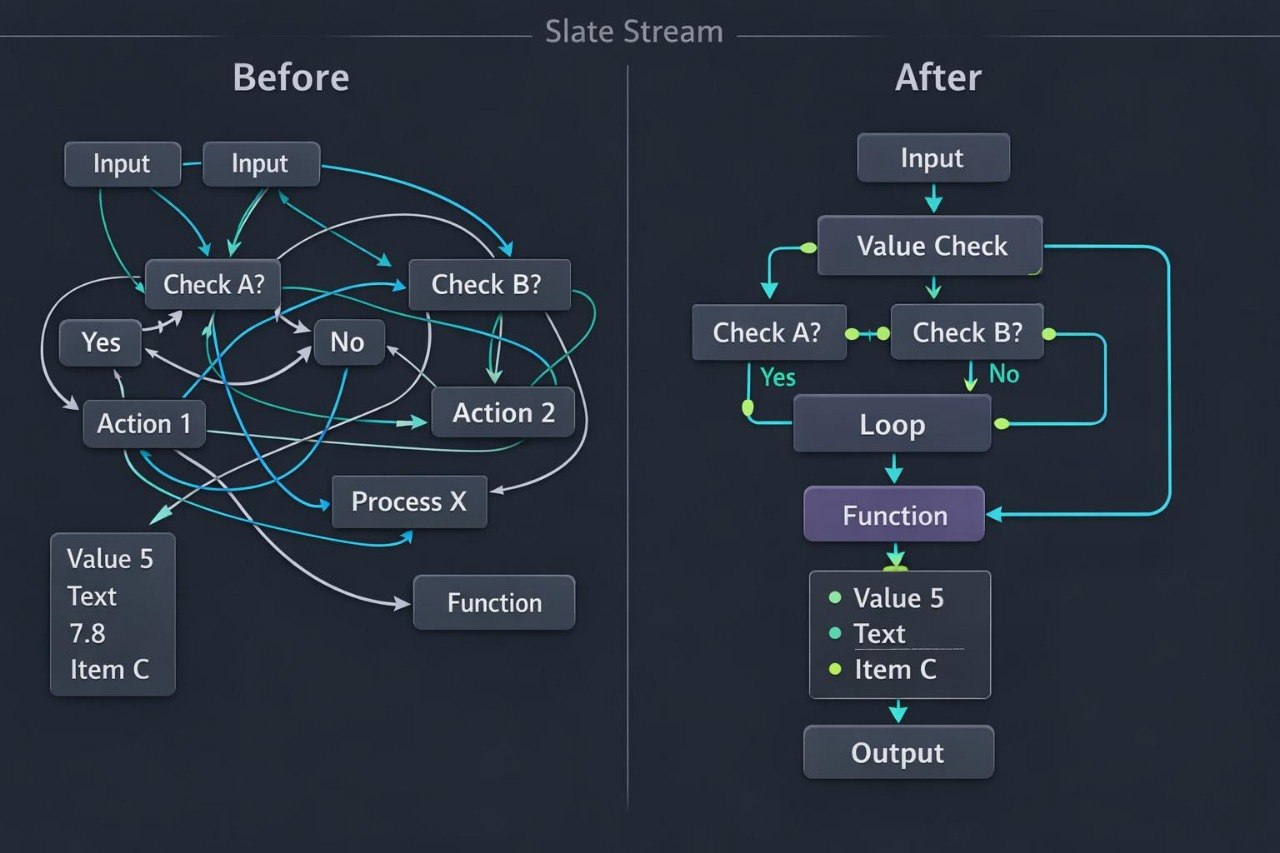
Struggling to understand how data moves between different parts of your code? You’re not alone. Beginners can often create a variable, condition, or loop separately but become uncertain when these elements must work together. This may lead to repeated commands, unclear names, and actions without an organized sequence. It can also be difficult to identify where a value changed or why a particular condition did not run. Slate Stream helps you examine code as a connected flow of operations.
2. Solution
This course will teach you how to combine foundational Python structures into understandable scenarios. You will examine data input, value checks, repeated operations, and basic functions. Each module explains how one section of code passes information to the next. Exercises invite you to trace changing values and correct common logical issues. At the end, you will build a compact program that processes a data sequence.
3. What’s Inside
Module 1: Following the Data Flow
Trace where a value begins, where it is stored, and how it changes while commands are executed.
Module 2: Input and Value Checks
Work with entered data, type conversion, and foundational value checks before further processing.
Module 3: Conditional Paths
Create several logical branches and examine how the order of conditions affects the output.
Module 4: Loops and Counters
Practise loops, counters, accumulated values, and controlled repetition.
Module 5: Function Foundations
Group related commands into functions, pass arguments, and return calculated values.
Module 6: Lists and Data Sequences
Explore lists, indexes, element iteration, and sequence updates.
Module 7: Stream Practice Task
Combine input, validation, a list, a loop, conditions, and a function in one final exercise.
4. Who Is This For?
✅ Suitable if you:
- understand common data types and variables;
- want to connect several structures in one scenario;
- would like to read execution sequences more clearly;
- are ready to work with functions and lists.
❌ Not for you if you:
- have not studied variables, conditions, or loops;
- need material about complex libraries or large systems;
- expect individual review of every exercise.
5. What You’ll Learn
After completing the course, you will be able to:
- trace data movement between commands;
- check and convert entered values;
- create several conditional paths;
- use loops, counters, and accumulators;
- write functions with arguments and return values;
- add, update, and iterate through list elements;
- identify foundational logical issues;
- complete a program using at least five connected structures.
6. Guarantee
Slate Stream includes a 30-day money-back condition. You may submit a refund request within 30 calendar days of purchase according to the store policy. This allows you to begin reviewing the materials in a risk-free format and evaluate how the course structure fits your learning preferences.
7. Certificate
After completing all seven modules and the final task, the learner may receive a Codivra Slate Stream completion certificate. It confirms course completion but does not represent a professional licence or employment credential.
1. What format do Codivra courses use?
1. What format do Codivra courses use?
The courses combine sequenced modules, written explanations, code examples, practical exercises, and topic-based tasks. The amount and depth of the materials depend on the selected plan.
2. Are the materials suitable for beginners?
2. Are the materials suitable for beginners?
Yes. The introductory plans begin with foundational concepts and explain each topic gradually. The expanded plans include additional practice, broader structures, and more detailed assignments.
3. How long can I spend studying the materials?
3. How long can I spend studying the materials?
You can study at your own pace. Topics may be reviewed, examples may be repeated, and exercises may be completed in a suitable order according to the conditions of the selected plan.
Share