Codivra
Loom Suite
Loom Suite
Couldn't load pickup availability
Self-paced learning overview
- 📥 Digital file available after purchase
- ♾️ Long-term availability
- 🔒 Secure checkout
- 📅 Content updated in 2026
1. Problem Statement
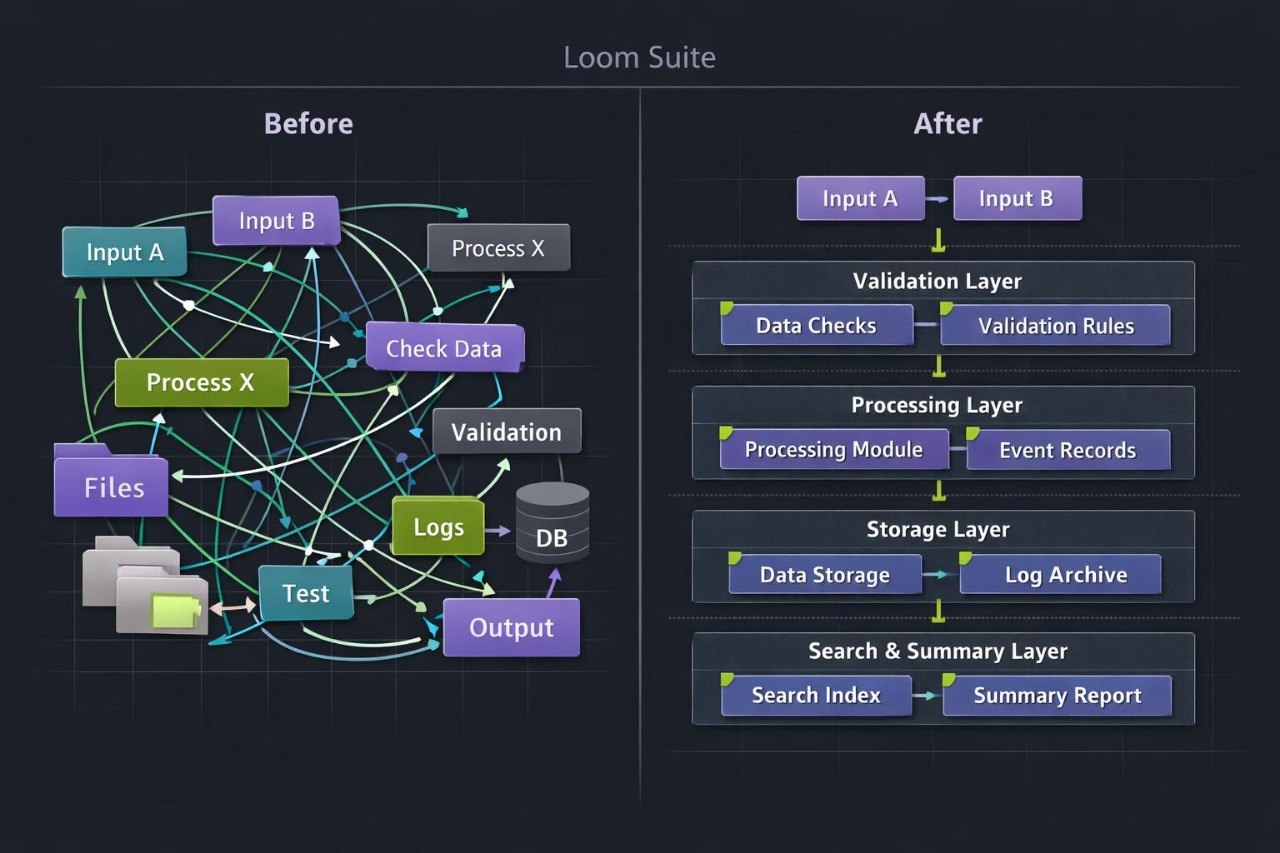
Struggling to connect different parts of a Python project into one understandable system? You’re not alone. After studying functions, data structures, files, generators, and validation rules, learners may still be uncertain about how these elements should work together. Without an initial plan, components may have unclear responsibilities, repeat the same operations, or exchange information in inconsistent formats. A change in one block may then affect several other sections of the program. Loom Suite helps establish a sequenced architecture in which information passes through defined stages.
2. Solution
This course will teach you how to plan and build a multi-component Python project for structured data work. You will examine task distribution between modules, object organization, input validation, and final result preparation. The materials explain how to connect components through clearly defined parameters and return values. Practical tasks cover reading, cleaning, grouping, calculating, storing, and testing information. The final project combines these stages into one controlled workflow.
3. What’s Inside
Module 1: Project Scope and Data Plan
Define the project purpose, input record format, expected outputs, and boundaries of each component.
Module 2: Component Architecture
Divide the program into sections for input, validation, processing, storage, and result preparation.
Module 3: Data Models and Objects
Create structures representing records, connected values, and rules for updating them.
Module 4: Validation Layer
Build separate checks for data types, ranges, required fields, and expected formats.
Module 5: Processing Pipeline
Create a sequence for cleaning, converting, filtering, and grouping information.
Module 6: File Input and Output
Read structured files, prepare updated records, and store processed results.
Module 7: Search and Summary Logic
Build searches using several parameters, categorize records, calculate totals, and prepare summary tables.
Module 8: Error and Event Records
Record incorrectly formatted entries, processing events, and reasons why information was set aside.
Module 9: Component Testing
Check separate functions and components with several input collections.
Module 10: Refactoring and Documentation
Organize naming, reduce repeated operations, and add explanations to key code sections.
Module 11: Performance Review
Compare processing approaches and identify areas containing unnecessary operations.
Module 12: Loom Data System
Combine every module into a system that reads, checks, updates, groups, and stores information.
4. Who Is This For?
✅ Suitable if you:
- have completed earlier Python and data-logic topics;
- have worked with functions, files, generators, and exceptions;
- want to create a project containing several connected components;
- are ready to plan a structure before writing the main code.
❌ Not suited if you:
- are only beginning with variables and conditions;
- need a brief introduction without a final project;
- do not plan to complete independent practical tasks.
5. What You’ll Learn
After completing the materials, you will be able to:
- prepare a plan for a multi-component project;
- divide responsibilities between modules;
- create models for structured records;
- build a separate data-validation layer;
- connect cleaning, filtering, and grouping stages;
- read and write structured files;
- create searches using several criteria;
- record invalid entries and processing events;
- test individual components;
- reorganize code and supporting explanations;
- build a system with at least seven connected components;
- process a collection containing one hundred or more records.
6. Refund Terms
Loom Suite includes a 30-calendar-day period for submitting a refund request. Requests are reviewed according to the published store policy and the stated course purchase conditions. Learners should review the included modules, learning materials, and request procedure before placing an order.
7. Certificate
After completing all twelve modules and the final project, the learner may receive a Codivra Loom Suite completion certificate. It confirms completion of the stated course but does not represent an academic diploma, occupational licence, or employment credential.
1. What format do Codivra courses use?
1. What format do Codivra courses use?
The courses combine sequenced modules, written explanations, code examples, practical exercises, and topic-based tasks. The amount and depth of the materials depend on the selected plan.
2. Are the materials suitable for beginners?
2. Are the materials suitable for beginners?
Yes. The introductory plans begin with foundational concepts and explain each topic gradually. The expanded plans include additional practice, broader structures, and more detailed assignments.
3. How long can I spend studying the materials?
3. How long can I spend studying the materials?
You can study at your own pace. Topics may be reviewed, examples may be repeated, and exercises may be completed in a suitable order according to the conditions of the selected plan.
Share