Codivra
Grid Pattern
Grid Pattern
Couldn't load pickup availability
Self-paced learning overview
- 📥 Digital file available after purchase
- ♾️ Long-term availability
- 🔒 Secure checkout
- 📅 Content updated in 2026
1. Problem Statement
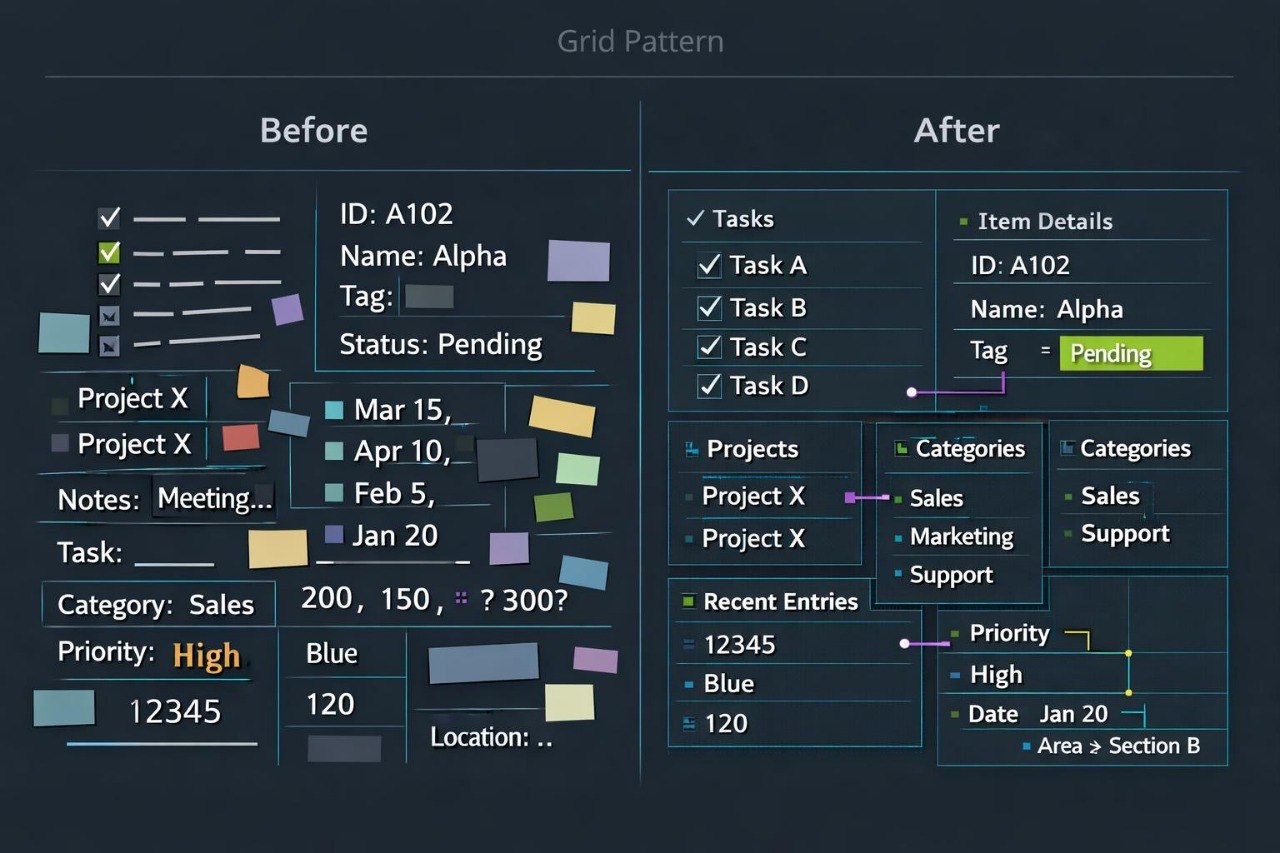
Struggling to work with data when it no longer fits into one simple list? You’re not alone. When learners move toward broader tasks, they often encounter nested lists, dictionaries, and several connected loops. Without an organized structure, values may be duplicated, omitted, or processed in the wrong order. It can also become difficult to identify which function is responsible for a particular operation. Grid Pattern helps organize data and logic as separate but connected blocks.
2. Solution
This course will teach you how to create structured data models with lists, dictionaries, tuples, and sets. You will examine how to select a suitable structure for a specific task. Particular attention is given to nested data, processing functions, and sequenced output checks. Practical exercises involve sorting, grouping, filtering, and updating information. At the end, you will create a compact system for storing and processing connected records.
3. What’s Inside
Module 1: Choosing a Data Structure
Compare lists, dictionaries, tuples, and sets, and identify the tasks suited to each format.
Module 2: Working With Dictionaries
Study keys, values, record updates, data checks, and iteration through key-value pairs.
Module 3: Nested Data Patterns
Read and update structures in which lists contain dictionaries or dictionaries contain several sequences.
Module 4: Filtering and Grouping
Select elements by condition, divide records into categories, and calculate grouped results.
Module 5: Sorting Data Records
Sort numbers, text values, and records according to selected fields.
Module 6: Reusable Processing Functions
Create functions for checking, updating, searching, and summarizing information.
Module 7: Handling Missing or Incorrect Values
Identify absent values and process information that does not match the expected format.
Module 8: Grid Data Project
Combine nested structures, filtering, sorting, and functions in one final scenario.
4. Who Is This For?
✅ Suitable if you:
- understand variables, conditions, loops, and foundational functions;
- want to work with dictionaries and nested information;
- would like to organize program logic more clearly;
- are ready for tasks with several processing stages.
❌ Not for you if you:
- have not yet worked with lists or functions;
- need material focused only on foundational syntax;
- expect topics involving large software systems or complex mathematical models.
5. What You’ll Learn
After completing the course, you will be able to:
- select a data structure for a defined task;
- create and update dictionaries;
- read nested data collections;
- filter records using several conditions;
- group information into categories;
- sort records by a selected field;
- create functions for repeated processing;
- check missing and incorrectly formatted values;
- complete a project containing at least ten connected records.
6. Guarantee
Grid Pattern includes a 30-day money-back condition. A refund request may be submitted within 30 calendar days of purchase according to the store policy. This provides a risk-free way to review the modules and practical tasks before continuing through the full course.
7. Certificate
After completing all eight modules and the final project, the learner may receive a Codivra Grid Pattern completion certificate. It confirms completion of the learning materials but does not represent a professional licence or employment credential.
1. What format do Codivra courses use?
1. What format do Codivra courses use?
The courses combine sequenced modules, written explanations, code examples, practical exercises, and topic-based tasks. The amount and depth of the materials depend on the selected plan.
2. Are the materials suitable for beginners?
2. Are the materials suitable for beginners?
Yes. The introductory plans begin with foundational concepts and explain each topic gradually. The expanded plans include additional practice, broader structures, and more detailed assignments.
3. How long can I spend studying the materials?
3. How long can I spend studying the materials?
You can study at your own pace. Topics may be reviewed, examples may be repeated, and exercises may be completed in a suitable order according to the conditions of the selected plan.
Share