Codivra
Drift Suite
Drift Suite
Couldn't load pickup availability
Self-paced learning overview
- 📥 Digital file available after purchase
- ♾️ Long-term availability
- 🔒 Secure checkout
- 📅 Content updated in 2026
1. Problem Statement
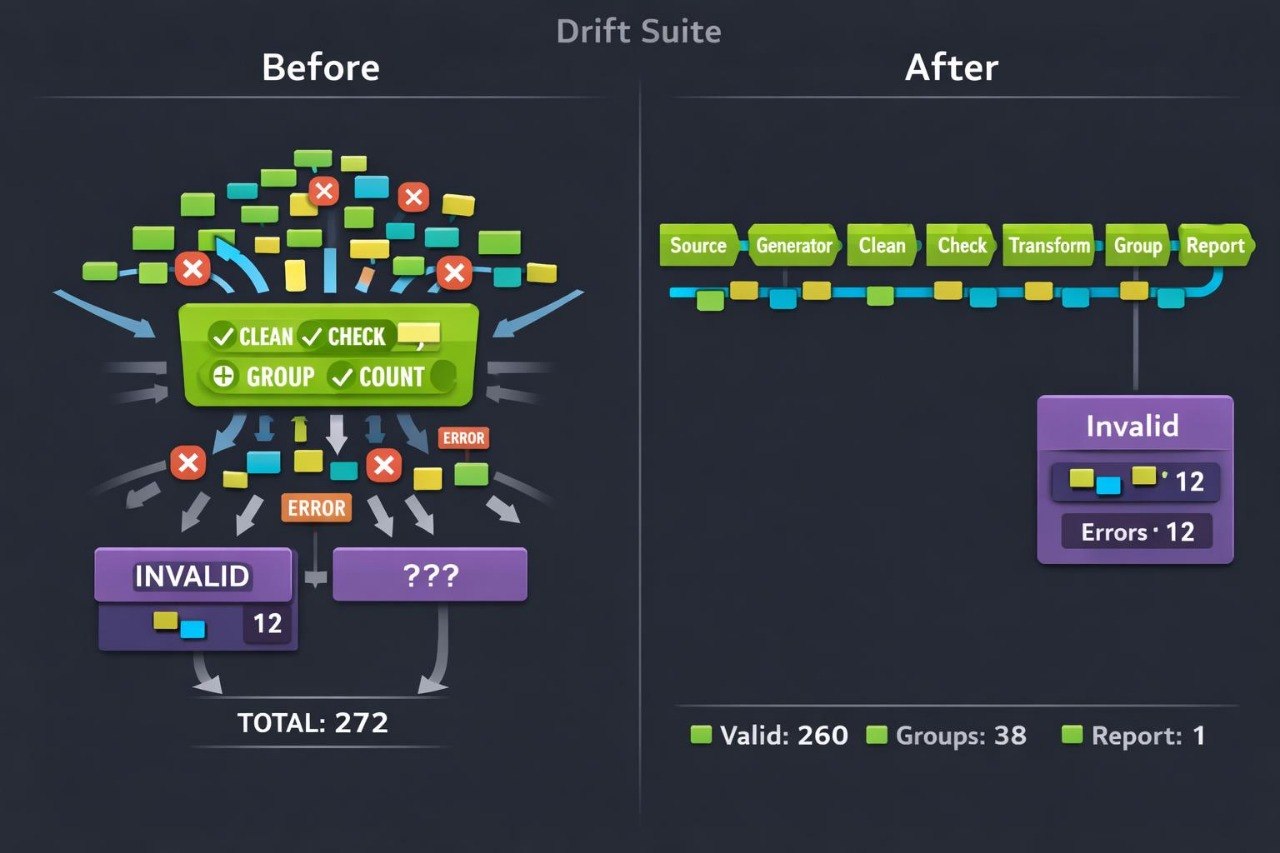
Struggling to follow data as it moves through many connected stages? You’re not alone. In broader tasks, records may be read, cleaned, filtered, grouped, and updated by several functions. When all operations are placed together, identifying which component caused a particular change becomes difficult. Larger collections may also require a different approach from storing every value inside one list. Drift Suite helps you build sequenced data flows in which each stage has a defined responsibility.
2. Solution
This course will teach you how to design multi-stage data-processing workflows in Python. You will examine iterators, generators, transformation functions, component separation, and methods for retaining intermediate state. The materials show how to pass records between stages without combining unrelated operations inside one large block. Practical exercises cover gradual data reading, filtering, grouping, counting, and preparation of final structures. At the end, you will build a system that processes records through several connected stages.
3. What’s Inside
Module 1: Designing a Data Pipeline
Define the data source, processing sequence, and expected output of every stage.
Module 2: Iteration Beyond Basic Loops
Examine iteration protocols, iterable objects, and controlled retrieval of sequential values.
Module 3: Generator Foundations
Create generators that provide values gradually and support work with longer sequences.
Module 4: Chained Data Transformations
Pass results through several functions responsible for cleaning, conversion, and checking.
Module 5: Stateful Processing
Retain counters, categories, and intermediate summaries while records move through the workflow.
Module 6: Structured Components
Create components that keep related information and operations together.
Module 7: Record Mapping and Reduction
Update individual records, select relevant elements, and prepare grouped calculations.
Module 8: Batch and Stream Approaches
Compare processing an entire collection at once with handling records sequentially.
Module 9: Tracking Processing Events
Prepare internal messages that show execution order and the state of each stage.
Module 10: Recovery From Invalid Records
Separate incorrectly formatted records while continuing to process the remaining collection.
Module 11: Drift Pipeline Project
Combine reading, cleaning, checking, conversion, grouping, and report preparation in one project.
4. Who Is This For?
✅ Suitable if you:
- have worked with functions, files, and exception handling;
- want to process information through several sequenced stages;
- are ready to study generators and iterable objects;
- would like to separate component responsibilities more clearly.
❌ Not suited if you:
- have not worked with functions or data structures;
- need only foundational syntax exercises;
- do not plan to complete a multi-component final project.
5. What You’ll Learn
After completing the materials, you will be able to:
- outline a multi-stage data flow;
- create custom generators;
- pass values between processing stages;
- retain intermediate counters and summaries;
- separate checking, cleaning, and conversion tasks;
- compare batch and sequential approaches;
- isolate incorrectly formatted records;
- trace component execution order;
- build a workflow containing at least six connected stages;
- process a collection of fifty or more structured records.
6. Refund Terms
Drift Suite includes a 30-calendar-day period for submitting a refund request. Requests are reviewed according to the published store policy and the stated course purchase conditions. Learners should review the module description, included materials, and refund terms before placing an order.
7. Certificate
After completing all eleven modules and the final project, the learner may receive a Codivra Drift Suite completion certificate. It records completion of the stated learning materials and does not represent an academic diploma, occupational licence, or employment credential.
1. What format do Codivra courses use?
1. What format do Codivra courses use?
The courses combine sequenced modules, written explanations, code examples, practical exercises, and topic-based tasks. The amount and depth of the materials depend on the selected plan.
2. Are the materials suitable for beginners?
2. Are the materials suitable for beginners?
Yes. The introductory plans begin with foundational concepts and explain each topic gradually. The expanded plans include additional practice, broader structures, and more detailed assignments.
3. How long can I spend studying the materials?
3. How long can I spend studying the materials?
You can study at your own pace. Topics may be reviewed, examples may be repeated, and exercises may be completed in a suitable order according to the conditions of the selected plan.
Share