Codivra
Cipher Suite
Cipher Suite
Couldn't load pickup availability
Self-paced learning overview
- 📥 Digital file available after purchase
- ♾️ Long-term availability
- 🔒 Secure checkout
- 📅 Content updated in 2026
1. Problem Statement
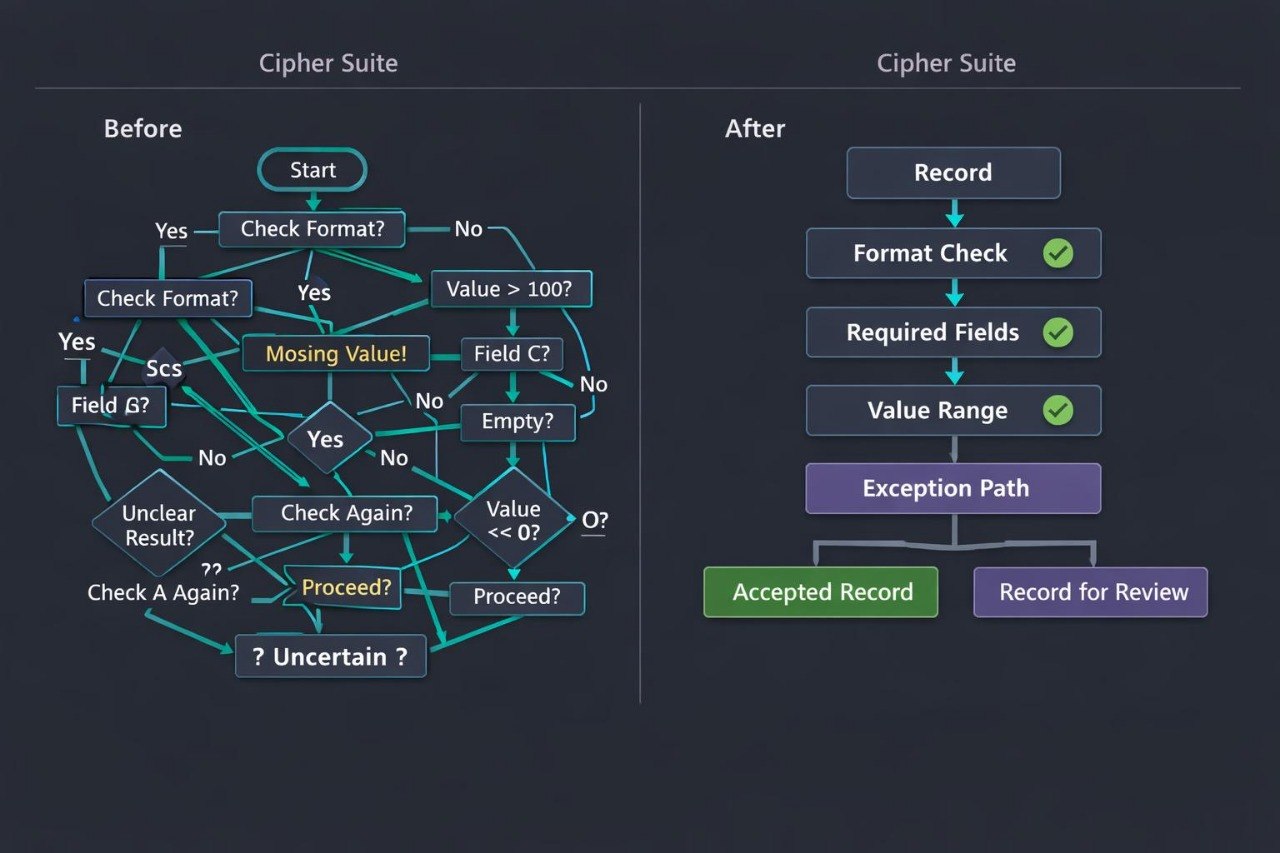
Struggling to keep your logic clear when one task contains many rules and exceptions? You’re not alone. In broader Python projects, data may arrive in different formats and require several levels of checking. When every condition is placed inside one large block, the code becomes harder to read, revise, and test. A small issue in the order of checks may affect later calculations or produce an incorrect result. Cipher Suite shows how to divide complex rules into separate logical components.
2. Solution
This course will teach you how to create sequenced systems for checking and processing data. You will examine combined conditions, helper functions, exception handling, and result verification. Each module explains how to separate one rule from another and define the order in which they should run. Practical tasks include checking text and numeric values, working with structured records, and reviewing intermediate results. In the final project, you will build a multi-stage validation system for a collection of data.
3. What’s Inside
Module 1: Mapping Validation Rules
Convert data requirements into separate, readable checks.
Module 2: Combined Conditions
Work with logical operators, nested conditions, and expression order.
Module 3: Text and Number Validation
Check text length, value formats, numeric ranges, and defined criteria.
Module 4: Reusable Rule Functions
Create compact functions, with each one responsible for a specific rule.
Module 5: Exception Paths
Handle missing, damaged, or unexpected values without stopping the entire process.
Module 6: Structured Record Checks
Review dictionaries and record lists for required fields and suitable value formats.
Module 7: Result Messages and Statuses
Prepare readable messages explaining which rule was met or not met.
Module 8: Testing Separate Components
Run functions with different input collections and compare their results.
Module 9: Refactoring Complex Conditions
Divide long conditional structures into shorter functional blocks.
Module 10: Cipher Validation Project
Combine checks, exception handling, status preparation, and summary output in one project.
4. Who Is This For?
✅ Suitable if you:
- have worked with functions, files, and data structures;
- want to organize tasks containing many rules;
- would like to improve input checking;
- are ready to examine several code paths.
❌ Not for you if you:
- have not studied conditions or functions;
- need only introductory exercises;
- do not plan to work with multi-stage checks.
5. What You’ll Learn
After completing the course, you will be able to:
- convert written requirements into logical rules;
- create combined conditions;
- check text and numeric values;
- divide checks among separate functions;
- handle missing and incorrectly formatted data;
- prepare readable result statuses;
- test components across several scenarios;
- simplify long conditional blocks;
- build a system with at least eight separate rules;
- review a collection containing twenty-five or more records.
6. Refund Terms
Cipher Suite includes a 30-calendar-day period for submitting a refund request. Requests are reviewed according to the store policy and the stated purchase conditions. During this period, learners may review the opening modules and assess whether the format aligns with their study goals.
7. Certificate
After completing all ten modules and the final project, the learner may receive a Codivra Cipher Suite completion certificate. It confirms completion of the stated materials and does not represent an academic diploma, occupational licence, or employment credential.
1. What format do Codivra courses use?
1. What format do Codivra courses use?
The courses combine sequenced modules, written explanations, code examples, practical exercises, and topic-based tasks. The amount and depth of the materials depend on the selected plan.
2. Are the materials suitable for beginners?
2. Are the materials suitable for beginners?
Yes. The introductory plans begin with foundational concepts and explain each topic gradually. The expanded plans include additional practice, broader structures, and more detailed assignments.
3. How long can I spend studying the materials?
3. How long can I spend studying the materials?
You can study at your own pace. Topics may be reviewed, examples may be repeated, and exercises may be completed in a suitable order according to the conditions of the selected plan.
Share